

How To Choose The Right Prime Lens For Portrait
There is a specific kind of clarity that only exists when you stop zooming and start moving your feet. I spent years shooting with 24-70mm f/2.8 lenses because they were "safe," but safety doesn't always yield the best portraits. Prime lenses force you to commit to a focal length, which forces you to see the scene differently. Choosing the right one isn't about specs; it's about how you intend to stand relative to your subject and what kind of background separation you need to tell their story.
Our Top Picks
Affiliate disclosure: if you buy through these links, we may earn a commission at no extra cost to you.

Table of Contents
Quick Answer
For most portrait photographers, a 50mm f/1.4 or f/1.8 is the essential first prime because it mimics human vision and offers excellent value. If you shoot in tighter spaces or want that creamy background blur (bokeh), move up to an 85mm f/1.4 or f/1.8. Avoid wide-angle primes like 35mm for head-and-shoulders portraits unless you are intentionally distorting features for artistic effect.
The Focal Length Hierarchy
Focal length dictates perspective, not just magnification. When you shoot a face with a 35mm lens close up, the nose looks larger than the ears. This is often called "facial distortion," though it's really just accurate geometry being misinterpreted by our brains. For traditional, flattering portraits, you want to stand further back. The 50mm lens is the standard "nifty fifty" for a reason: on a full-frame camera, it provides a natural perspective that feels intimate without warping facial features.
The 85mm is the portrait workhorse. It allows you to compress the background slightly, making it appear closer to the subject and easier to blur out. If you are shooting environmental portraits where you need to show the subject in their workspace or home, the 35mm or 50mm is your friend. But for headshots and tight three-quarter shots, the 85mm gives you the separation needed to isolate the eyes from a busy backdrop.
Aperture: Bokeh vs. Sharpness
We obsess over f/1.2 and f/1.4 apertures for the shallow depth of field, but in professional work, I rarely shoot wide open. An f/1.4 lens will give you that dreamy, creamy background blur, but your subject's eyes might be tack sharp while their ears are soft. For commercial headshots or wedding portraits where every eye must be in focus, an f/2.8 lens is often more practical than an f/1.4.
However, do not underestimate the light-gathering ability of fast primes. Shooting a candlelit dinner or a dimly lit church requires an f/1.4 or f/1.8 to keep your ISO manageable and your shutter speed high enough to freeze motion. The "bokeh" is a bonus feature; the real utility of a fast prime is its ability to function in low light where zoom lenses would force you into noise-heavy territory.
Build Quality and Ergonomics
Prime lenses are generally lighter than zooms, but weight distribution matters when you are holding a camera up to your eye for an hour. I prefer metal mount primes over plastic ones because they feel more durable against accidental bumps against doorframes or tripods. Look for lenses with a well-damped focus ring. If the focus ring is too stiff, you will fatigue quickly; if it is too loose, you will lose your focus point when adjusting depth of field.
Consider the physical size of the lens relative to your camera body. A massive 85mm f/1.2 on a small mirrorless body looks top-heavy and can strain the mount over time. A balanced rig encourages you to keep shooting rather than putting the gear down because it feels cumbersome. Also, check if the lens has a dedicated aperture ring. For video work or precise exposure control, a clickless aperture ring is invaluable.
Autofocus Performance in the Field
Fast apertures make autofocus harder for the camera's sensor because the depth of field is so thin. A lens might hunt back and forth in low light, especially if the subject is wearing dark clothing against a dark background. When testing a prime lens, look for reviews that mention "focus breathing" (the image zooming slightly as you focus) if you shoot video. For stills, prioritize consistency over speed.
Modern mirrorless cameras have excellent eye-AF, but the lens motor still plays a role. Ultrasonic motors (USM, SWM, HSM) are generally quiet and fast. If you are shooting a wedding or an event where silence is required, avoid older lenses with loud screw-drive autofocus motors. A silent lens allows you to capture candid moments without alerting your subjects.
Crop Sensor Considerations
If you are shooting on an APS-C or Micro Four Thirds camera, remember that focal length is multiplied. A 50mm lens on an APS-C body acts like a 75mm or 80mm lens. This can actually be beneficial for portraits, as it pushes you further back, flattening facial features nicely. However, it means your "standard" prime might feel too tight for environmental shots.
On crop sensors, a 35mm lens becomes roughly a 50-56mm equivalent, making it a versatile all-rounder. An 85mm on crop becomes a ~128mm lens, which is excellent for tight headshots but terrible for group photos in small rooms. Calculate your effective focal length before buying to ensure the lens fits your shooting environment.
Frequently Asked Questions
Is a 50mm or 85mm better for beginners?
An 85mm is generally more forgiving for portraits because it compresses the background and flatters facial features. A 50mm requires you to be closer to your subject, which can sometimes lead to awkward posing.
Do I need a full-frame camera for prime lenses?
No. Prime lenses work on crop sensors, but the effective focal length changes. You just need to account for the "crop factor" when planning your shots.
Can I use a prime lens for group portraits?
Yes, but you may need to step back significantly. A 50mm or wider is better for groups than an 85mm, which requires too much distance to fit more than two people comfortably.
Why are prime lenses so expensive?
They require complex glass elements to correct aberrations at wide apertures. Also, the market is smaller than zooms, so R&D costs are spread over fewer units.
Should I buy manual focus or autofocus primes?
For still photography, autofocus is essential for speed and accuracy
🛒 Relevant Products for This Topic
Affiliate disclosure: if you buy through these links, we may earn a commission at no extra cost to you.
Viltrox AF 56mm f/1.4 XF STM APS-C Frame Auto Focus Standard Prime Lens for...
$239.0
View Product Details →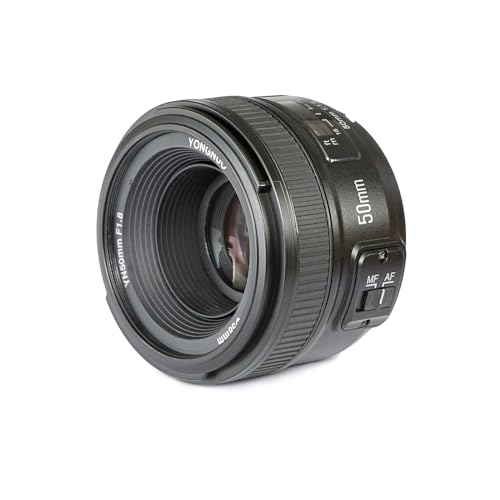
YONGNUO YN50mm F1.8N Standard Prime Lens AF for Nikon F-Mount DSLR Cameras
$102.0
View Product Details →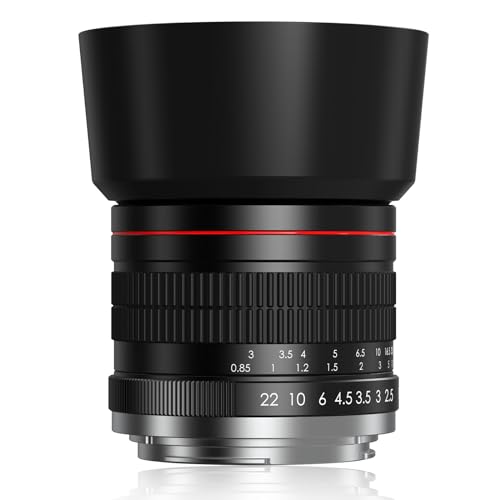
85mm f1.8 Portrait Lens EF Lens for Canon, Manual Focus (MF) for Canon EOS...
$96.22
View Product Details →

