

How to Choose the Right Tripods
Our Top Picks
Affiliate disclosure: if you buy through these links, we may earn a commission at no extra cost to you.

A tripod isn't glamorous. Nobody buys a camera system because of the tripod. But I've burned more shoots—literally squandered light and location—because I had the wrong tripod than I have because of any lens choice. A wobbly support system undermines everything else: sharpness evaporates, compositions shift mid-frame, and you spend energy fighting the tool instead of making images.
The good news is that choosing the right tripod is straightforward once you stop thinking about specs in isolation and start thinking about how you actually work. It's about understanding the trade-offs between weight, stability, height, and portability—and being honest about what matters most for your specific shooting.
K&F CONCEPT 64 inch/163 cm Camera Tripod,Lightweight Travel Outdoor DSLR Tripods with 360 Degree Ball Head Load Capacity 17.6 lbs/8 kg,Cellphone Clip for Smartphone Live Streaming Vlog O234A1+BH-36
$49.99Check Price


Table of Contents
- Understanding Load Capacity vs. Real-World Stability
- Height, Reach, and Ergonomics in the Field
- Material Choices: Aluminum, Carbon Fiber, and Weight Trade-Offs
- Tripod Head Fundamentals—Ball, Fluid, and Pan-Tilt
- Portability vs. Stability: Finding Your Balance
- Specialty Considerations for Video, Landscape, and Event Work
- Frequently Asked Questions
- Frequently Asked Questions
Understanding Load Capacity vs. Real-World Stability
Manufacturers love publishing load ratings. "Supports 15 kg!" they'll scream. That number is technically accurate but practically misleading. It's the absolute maximum before catastrophic failure—not the point where your kit behaves predictably.
I work with a working weight rule: load your tripod to roughly 30-40% of its stated capacity for day-to-day work. If a tripod is rated for 10 kg and you're mounting a 2.8 kg camera with a 1.5 kg lens and a 0.5 kg head, you're using 4.3 kg—plenty of headroom. But when wind picks up, or you're shooting long exposures with remote releases, or you're working on uneven ground and leaning slightly into the frame, that 60-70% safety margin becomes essential.
The instability doesn't announce itself loudly. It shows up as micro-vibrations in long exposures, compositional drift when you're checking frames, and that unsettling feeling that something isn't quite locked down. Cheaper tripods often feel "spongy"—not because they're at load capacity, but because their materials and leg-locking mechanisms tolerate more flex at any load level.
Height, Reach, and Ergonomics in the Field
Most tripods max out around 55-65 inches with the center column fully extended. On paper, that sounds adequate. In practice, it's a compromise between portability and ergonomic reality. When I'm shooting at eye level without hunching—the position where I can actually see through the viewfinder comfortably—I need about 58-60 inches. If I'm shooting landscape and need dead-level compositions, I often work lower. If I'm shooting an event from the back of a venue, I might need higher.
Center column extension matters more than you'd think. A tripod with 55-inch max height from leg extension alone, plus a 6-inch center column, gives you flexibility that an identical-height model without center column doesn't. But here's the caveat: extending a center column moves your weight up and back, reducing stability slightly. Never fully extend the center column in moderate wind or when pushing load capacity.
Ergonomics determine whether you'll actually use the tripod or leave it in the car. If you're constantly adjusting and readjusting because leg angles are awkward or the head is sluggish, friction creeps in. Twist-lock legs are faster than flip-locks for me, but they're also noisier and feel less premium. Flip-locks are quieter but require a second hand. Try both if possible. Your shooting environment dictates which is less annoying in practice.
Material Choices: Aluminum, Carbon Fiber, and Weight Trade-Offs
Aluminum tripods are stiff, durable, inexpensive, and heavy. Carbon fiber is lighter, more expensive, and marginally stiffer. In practical terms: if you're hiking to locations or shooting events where you're moving between setups frequently, carbon fiber saves fatigue. If you're in a studio or shooting from a car, aluminum is fine and will outlast carbon fiber by years.
The weight difference is real but not magical. A typical aluminum tripod weighs 3.5-4.5 kg; carbon fiber versions weigh 2-2.5 kg. Over an eight-hour shoot, that 1.5-2 kg difference compounds. Your shoulder and lower back notice. But carbon fiber legs can become brittle in extreme cold, and carbon fiber sections can eventually crack at the connection points if they take impacts. Aluminum dents, but it doesn't fail catastrophically from a drop.
There's also a middle ground: some manufacturers use carbon fiber legs with aluminum center columns, or aluminum top sections with carbon fiber legs. These are worth considering if you want the weight savings where it matters most—the legs—while keeping the durability and stiffness of aluminum for components that see stress points.
Tripod Head Fundamentals—Ball, Fluid, and Pan-Tilt
The head is where intention meets reality. The tripod legs are just structure; the head is control. Ball heads are compact and intuitive for single-shot composition—loosen a single friction knob and reposition. Fluid heads (or damped heads) use internal friction mechanisms to keep position locked while allowing smooth adjustments. Pan-tilt heads lock each axis independently, forcing you to adjust vertical and horizontal separately.
For stills photography, a good ball head is usually sufficient. The friction mechanism should be smooth and predictable—not "loose-then-suddenly-locked" but genuinely progressive. Test one before buying. For video or long exposures where you need absolutely zero drift after locking, a quality fluid or damped ball head is worth the extra money. The internal mechanism doesn't rely on a single friction knob, so there's less lever arm and less creep when you're locked.
Pan-tilt heads are overkill for most stills work but valuable if you're splitting your time between stills and video. They force precision: you adjust vertically, lock it, adjust horizontally, lock it. No compromise positions. But they're heavier and slower to use when you're hunting for composition in real time.
One practical reality: cheap ball heads sound smooth in the shop but develop slop and inconsistency after 6-12 months of regular use. The friction mechanism wears, and you're back to that loose-then-locked feeling. Mid-range heads ($80-150) tend to have better longevity. Expensive heads ($250+) feel better and last longer, but for 90% of day-to-day photography work, a $100-120 ball head will serve you capably.
Portability vs. Stability: Finding Your Balance
This is the real tension. Lighter tripods are easier to transport but slightly less stable under stress. Heavier tripods are rock-solid but a burden over long days. The inflection point for most photographers is somewhere around 3.5-4 kg total with head. Below that, you're sacrificing stiffness. Above that, you're carrying weight you probably don't need.
Your shooting style determines where you land. Landscape photographers often prioritize stability—a shoot might involve a single location for 2-3 hours, so the tripod doesn't move. Event photographers need speed and portability—they're breaking down and relocating constantly, and a 5 kg tripod becomes a curse. Studio work? Weight doesn't matter; stability does.
Also consider packing configuration. A tripod that folds to 24 inches fits in camera bags and car trunks. One that only folds to 30+ inches becomes unwieldy and might not fit at all. Some photographers I know keep two tripods: a light, portable one for events and travel, and a heavier, more stable one for landscape and studio work. It's not redundant if the use cases are genuinely different.
One more practical point: collapsed length matters more than weight for travel. A 3-kg tripod that folds to 32 inches is more portable than a 2.5-kg one that folds to 26 inches—assuming your bag fits the first but not the second.
Specialty Considerations for Video, Landscape, and Event Work
Video work demands fluid or damped heads, not ball heads. The smoothness of pan and tilt motion reads on screen. Video shooters also often prefer slightly heavier tripods—the added mass dampens micro-vibrations that show up as jitter in footage. A 4-5 kg tripod with a fluid head and good spike feet (for gripping outdoor ground) is baseline for video work, not lightweight.
Landscape photographers care deeply about precise leveling. Tripods with built-in levels are convenient but not essential—a quality hand level ($10-15) works better and doesn't add weight. What matters is a quick-release plate that doesn't shift under the weight of a heavy lens or zoom. Some photographers use L-brackets that attach to the camera; others use simple Arca-Swiss-compatible plates. Both work, but the bracket approach is more stable when shifting between portrait and landscape orientation.
Event photographers need fast setup and breakdown. Small, portable tripods are valuable here, even if they sacrifice some stability. When you're photographing a reception in challenging light and need to move between the cocktail hour and the dinner, you want something that deploys in seconds. Fluid heads are slower to fine-tune than ball heads for stills work, so event shooters often opt for lighter ball-head setups.
Drone owners often overlook tripods for ground-based work while their drone is charging or while they're managing multiple cameras. A very light, compact tripod (under 2 kg, folds to under 20 inches) is useful for holding a secondary camera or even the controller at eye level. It's not a primary tool, but having one nearby is convenient.
Frequently Asked Questions
Should I buy a tripod with a built-in head or separate components?
Separate is more flexible long-term. You can upgrade the head without replacing the legs, and you have more head options. But bundled packages are often better value if you're just starting out. Once you know what you need, buying legs and head separately makes sense.
What's the difference between Arca-Swiss and other quick-release plate standards?
Arca-Swiss is an industry standard; most modern tripod heads and camera plates follow it. It's worth seeking out because you have options. Proprietary quick-release systems lock you into a single brand. If you ever upgrade the head, you might need new plates.
Are there tripods I should avoid entirely?
Yes. Anything under $50 is usually not worth owning—the friction mechanisms wear out quickly and the materials are often genuinely poor. Also avoid ultra-compact travel tripods for regular work
Consider three key factors: load capacity (ensure it supports your camera and lens weight), height and reach for your shooting style, and material choice between aluminum and carbon fiber. The right tripod should provide stable support without wobbling, as instability can ruin shots more often than poor lens choices. Aluminum tripods are typically more affordable and heavier, making them suitable for studio work, while carbon fiber tripods are lighter, more durable, and ideal for field work where you need portability. Carbon fiber comes at a premium price but offers better weight-to-stability trade-offs for professionals. Yes, investing in a quality tripod can prevent lost shoots and wasted lighting opportunities, making it one of the most important accessories in your camera kit. A wobbly or unstable tripod compromises image quality far more than many people realize, justifying the investment in a reliable model. Add the weight of your camera body, lens, and any additional accessories like microphones or lights, then choose a tripod with a load capacity exceeding that total. As a rule of thumb, your tripod should comfortably support at least 1.5-2 times your total gear weight for real-world stability. Choose a tripod that extends to your eye level without raising the center column, as this provides better ergonomics and stability in the field. Consider your typical shooting scenarios—compact tripods work for travel, while taller models suit studio work and varying terrain. Lightweight tripods (carbon fiber) are better for location shooting and travel, while heavier aluminum tripods offer superior stability for stationary studio setups. Your choice depends on your primary use case: if you're carrying it frequently, weight matters; if it stays in one place, stability should be prioritized.Frequently Asked Questions
How do I choose the right tripod for my camera?
What is the difference between aluminum and carbon fiber tripods?
Is it worth buying an expensive tripod?
How do I know the load capacity I need for my tripod?
What height and reach should I look for in a tripod?
How do I choose between lightweight and heavy tripods?
🛒 Relevant Products for This Topic
Affiliate disclosure: if you buy through these links, we may earn a commission at no extra cost to you.
K&F CONCEPT 64 inch/163 cm Camera Tripod,Lightweight Travel Outdoor DSLR...
$49.99
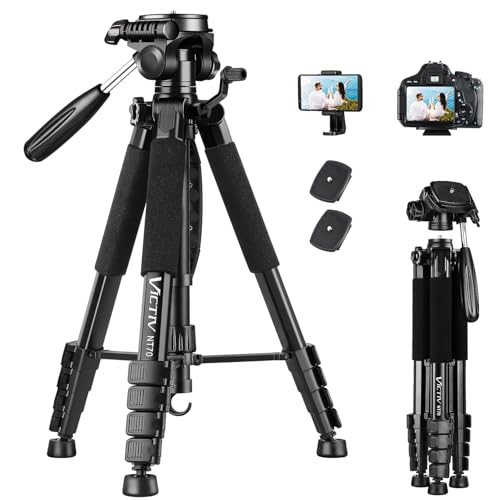
View Product Details →VICTIV 74” Camera Tripod, Tripod for Camera and Phone, Aluminum Professional...
$32.99
View Product Details →K&F CONCEPT X-Series 68" Carbon Fiber Camera Tripod,Professional Photography...
$129.99
View Product Details →

