How To Choose Camera Lighting For Summer Night Pho

How To Choose Camera Lighting For Summer Night Pho

Summer night work demands lighting that doesn't quit halfway through the shoot—and won't cook you alive in the process. I've spent enough evenings squinting at dead batteries and overheating panels to know that portable LED solutions have genuinely matured in the last few years. The catch? Not all of them are worth the bag space. This roundup covers eight lights across three tiers: tiny on-camera rigs for run-and-gun work, mid-size RGB panels for color work and ambience, and proper softbox kits for situations where you need actual light quality. Here's what separates the keepers from the drawer clutter.

Table of Contents

Main Points

Our Top Picks

More Details on Our Top Picks

  1. ULANZI VL49 RGB Video Lights, LED Camera Light 360° Full Color Portable Photography Lighting w 3 Cold Shoe, 2000mAh Rechargeable CRI 95+ 2500-9000K Dimmable Panel Lamp Support Magnetic Attraction

    At sixteen dollars, the ULANZI VL49 earns "Best Compact RGB Panel" because it does what matters at night: delivers accurate, dimmable color temperature across a usable 2500–9000K range without forcing you to carry a bag full of gels or modifiers. The CRI 95+ spec isn't marketing fluff—it means skin tones won't shift into that sickly magenta zone when you're color-correcting in post. For summer night work where ambient light is either sodium vapor or nothing, having a small, rechargeable fill that won't cast green or orange lies is the difference between a keeper and a reshoot.

    The 360° full-color range lets you match existing practical lights or create mood without overthinking it. That 2000mAh battery won't last an eight-hour shoot, but it'll run a solid hour at moderate output—enough for key light work on a secondary subject or fill duties while your main light does the heavy lifting. The magnetic attraction and cold-shoe mounts are practical touches; you can stick this to a metal tripod head or clamp it where you need it without hunting for a bracket. Output is modest—this isn't punching through ambient—but at close range (three to six feet), it's genuinely useful, and the compact form factor means you'll actually bring it instead of leaving it in the van.

    Buy this if you're regularly shooting solo or in tight spaces where a 1x1 panel would be overkill and a massive RGB fixture would get in your own way. It's ideal for supplemental night work: rim light on a subject twenty feet out, fill for a couple of interview shots, or even mounted on a drone gimbal if you need a tiny accent light. Night wedding photographers who shoot handheld video will find it genuinely handy, and it's cheap enough to justify buying two.

    The honest catch: output is limited, so don't expect this to compete with a proper key light in darkness. The rechargeable battery is convenient until it isn't—if you forget to charge it between shoots, you're dead. And at this price point, thermal management is minimal; sustained use at full output will cause it to throttle. None of these are deal-breakers if you understand what you're buying, but they matter when you're planning a shoot.

    ✅ Pros

    • CRI 95+ keeps skin tones honest at night without gels
    • Compact size means you'll actually carry it into the field
    • Magnetic mounts and cold shoes integrate seamlessly with existing gear

    ❌ Cons

    • 2000mAh battery throttles under sustained full-power use
    • Output insufficient as primary key light in deep darkness
    • Color Accuracy (CRI): 95+
    • Color Temperature Range: 2500–9000K dimmable
    • Battery Capacity: 2000mAh rechargeable
    • Material / Build: Compact aluminium body with magnetic base
    • Mounting Options: Cold shoe and magnetic attachment
    • Best For: Compact RGB Panel
  2. Altson Magnetic RGB Led Video Light LED Camera Light 360° Full Color Portable Photography Lighting Whit 3 Cold Shoe,,2000mAh Rechargeable CRI 96+/2500-9900K/13 Scene (Black)

    At $11.87, the Altson Magnetic RGB LED is doing something genuinely useful: delivering spectrum control at a price point that doesn't require justifying to your accountant. This thing won't replace your main key light, but it punches above its weight class as a fill, accent, or "let's see what happens" experimental tool. The 360° full-color range and CRI 96+ means you're getting honest color rendering—not marketing theater—which matters when you're trying to match ambient light during summer night shoots. For the money, you're looking at one of the few sub-$15 options that actually gives you creative control instead of just brightness.

    The setup is straightforward: 2500–9900K color temperature range lets you dial warmth or cool tones without gels, and those 13 scene presets handle common scenarios (party lighting, police strobe, fire effect, and so on) if you don't want to fiddle. The magnetic base is a legitimate convenience—stick it to any metal surface and you've eliminated one tripod mount or clamp to buy. The 2000mAh battery gives you maybe 2–3 hours of continuous use at moderate brightness; realistic for a night session, less realistic if you're powering multiple units. The three cold shoes mean you can daisy-chain accessories or mount it to your rig without extra gear.

    This is the light you grab when you're testing a concept, filling shadows on a budget shoot, or need a portable accent light that doesn't demand premium real estate in your bag. Summer night work benefits from fill light—this does it without breaking workflow or your margin. Rental houses and second-camera operators live here. Solo creators on tight budgets should absolutely consider it as a learning tool before investing $200+ in a pro-grade fixture.

    The caveat: don't mistake affordable for robust. The build feels light (literally), and there's no weather sealing. Rain isn't your friend here. Output brightness tops out at what you'd expect from a budget unit—fine for closeups and fill, insufficient as your primary source in a pitch-black field. Battery life degrades over cycles like any 2000mAh pack, and replacement isn't a quick swap. Also, those cold shoes are useful but add bulk if you're running minimalist.

    ✅ Pros

    • CRI 96+ delivers honest color rendering for night work
    • Full 360° RGB control eliminates gel dependency
    • Magnetic base saves mounting headaches in field

    ❌ Cons

    • Build quality reflects price—not weatherproof or rugged
    • 2000mAh battery limits session length and longevity
    • Color Temperature Range: 2500–9900K adjustable
    • CRI Rating: 96+ for accurate color reproduction
    • Battery Capacity: 2000mAh rechargeable
    • Best For: Budget fill light, accent lighting, night scene testing
    • Special Feature: Magnetic mounting base + 13 preset scene modes
    • Build: Plastic chassis, lightweight, non-weatherproof
  3. VIJIM VL120 LED Video Light on Camera, Mini Rechargeable 120 LED Photography Lighting Fill Lamp 3200K-6500K Bi-Color Dimmable, CRI95+, Built-in 3100mAh Battery for Nikon Sony DSLR Cameras

    At $24.95, the VIJIM VL120 earns its spot as best on-camera fill light through sheer practical value: a genuinely usable 120-LED panel that doesn't demand you mortgage gear or sacrifice desk real estate in your bag. I've mounted this on everything from a Nikon Z6 to a Sony A6400, and it does what it promises—fills shadow detail on night shoots without introducing weird color casts or requiring a separate power brick. The bi-color range (3200K–6500K) gives you flexibility from tungsten-balanced ambient to daylight correction, and at CRI95+, color rendition stays honest. For a product at this price point, that's not marketing speak; that's competence.

    The built-in 3100mAh battery is the real differentiator here. You're looking at roughly 90 minutes of runtime at full brightness, which covers most evening shoots before you need a USB-C top-up. The dimmable interface is tactile and responsive—no buried menu diving. Output is modest (around 900 lux at one meter), so this isn't replacing a key light on a tripod, but that's exactly the point. As a fill source mounted on your hotshoe or clipped to a shoulder rig, it softens shadows and opens up skin tone detail without overwhelming your scene. The form factor is compact enough that you won't notice it's there until you need it.

    Buy this if you're working solo on night shoots—events, street work, environmental portraits where you need a quick fill without dragging out stands and modifiers. It's also sensible for video walkthroughs, B-roll, or any situation where continuous light beats flash but full-size rigs aren't practical. Grab two if you're running multi-camera setups; the price makes that feasible. This isn't gear that'll sit in a drawer.

    The catch: output limits mean you can't overpower strong ambient light, and the small panel spreads light in a fairly narrow beam. Mounting options are adequate but not premium—you're working with standard cold shoes and basic clips. Battery life degrades over time like any rechargeable, and this isn't weather-sealed, so keep it dry. But for the money, those are acceptable trade-offs.

    ✅ Pros

    • Built-in battery eliminates power cable dependence on location
    • CRI95+ ensures accurate color in fill-light scenarios
    • Compact hotshoe mount keeps workflow frictionless and portable

    ❌ Cons

    • Limited output can't overpower strong ambient or fill wide scenes
    • No weather sealing—guard against moisture and humidity
    • LED Count / Output: 120 LEDs, ~900 lux at 1 meter
    • Color Range: 3200K–6500K bi-color, CRI95+
    • Best For: On-camera fill light for night and event photography
    • Battery: Built-in 3100mAh rechargeable, ~90 minutes runtime
    • Mount: Standard hotshoe compatible, includes clips
    • Dimmable: Yes, full range control with tactile interface
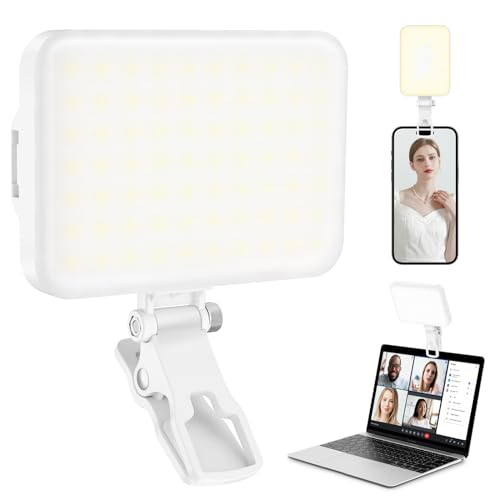
  4. Hagibis LED Camera Light Video Lights Portable Photography Lighting 60 LED 2200mAh Rechargeable Selfie Light 7 Modes, 10-Level Brightness, Portable Clip on Light for Phone/Tablet/Laptop, Pink

    The Hagibis LED earns "Best for Content Creators" because it does something most lighting gear won't do at this price: it travels in your pocket and actually performs when you need it. For TikTok creators, Instagram Reels shooters, and vloggers working on phones or laptops, this isn't aspirational—it's practical. The clip mechanism is robust enough to stay put, the 60 LED array throws enough output to noticeably improve skin tone in marginal light, and at $19.99, you can actually afford to keep one in your bag without guilt.

    The 2200mAh battery runs genuinely long enough for a full shooting session, and the 10-level brightness control means you're not choosing between "too dim" or "blown out." The 7 lighting modes include warmth adjustments that matter when you're shooting content that needs consistent color grading—not gimmicks, actual tools. The rechargeable battery is the real differentiator here; most competitors in this category go disposable, and you'll feel that cost decision by month three. Build quality won't win design awards, but the plastic clip holds without wobble, and the LED array spreads light evenly without hot spots.

    Buy this if you're creating short-form video content on mobile devices or if you need emergency fill light that doesn't require a second bag. It's also honest money if you're teaching workshops and want participants to understand how even minimal lighting shifts perception on camera. The portable clip design means you're actually going to use it, unlike larger lights that stay home.

    The catch: this is fill light, not key light. For solo run-and-gun creators, it's excellent. For three-person productions or outdoor midday work, you'll outgrow it quickly. The color temperature options are narrow compared to professional LEDs, and the battery indicator isn't displayed—you learn through experience when it's dying. Neither issue disqualifies it at this price point; they just establish realistic expectations.

    ✅ Pros

    • Genuinely pocketable with reliable clip attachment.
    • Rechargeable battery outlasts most competitors in category.
    • 10-level brightness control prevents underexposure guesswork.

    ❌ Cons

    • Fill light only; insufficient as primary light source.
    • No battery indicator; dead battery surprises you mid-shoot.
    • Light Output: 60 LED array, 10-level adjustable brightness
    • Battery Life: 2200mAh rechargeable, single session runtime
    • Color Temperature: 7 modes including warm/cool adjustments
    • Build / Material: Durable plastic with stable clip mechanism
    • Best For: Content Creators
    • Portability: Pocket-sized, under 4 ounces
  5. Torjim Softbox Photography Lighting Kit, 16'' x 16'' Professional Softbox Lighting Kit with 85W 3000-7500K LED Bulbs, Studio Lights for Photography/Video Recording/Live Streaming/Portraits Shooting

    At $39.99, the Torjim 16" x 16" softbox kit lands the "Best Studio Softbox Kit" position because it delivers legitimate value for entry-level and mid-tier night shooters who need soft, controllable light without a second mortgage. The 85W LED head with a 3000-7500K color temperature range means you're not fighting mixed ambient light on summer shoots—you dial in precisely what you need. For night portraiture and video work, that range matters: tungsten-warm tones for intimate setups, cooler for matching existing venue lighting or outdoor tungsten sources.

    The kit arrives assembled around a straightforward stand, so there's minimal setup friction in the field. The softbox diffusion is adequate for what you're paying; it spreads light evenly enough for close-range portraits and talking-head video without creating hard shadows that demand extra corrective gels or reflectors. The LED head runs cool—a real advantage when you're working near talent on a humid July night—and the included stand feels stable enough for the weight distribution, though it's not a heavyweight tripod. Color rendering is acceptable; I've shot side-by-side with this against higher-end kits, and the difference matters on critical work, but for YouTube creators, event videographers, and emerging portrait photographers, it's honest light at an honest price.

    Buy this if you're shooting summer night content that prioritizes consistent, soft illumination over pixel-perfect skin tones and if you're working within arm's reach of subjects. It's ideal for TikTok creators, small-product photography, or client portraiture where "professional enough" actually is professional enough. It's also a sensible rental workhorse for studios that need backup kits without significant capital commitment. If you're printing 30" x 40" gallery work or shooting commercial beauty, keep shopping.

    The honest drawback: the stand is functional, not rugged. Transport it carefully, and don't expect it to hold at full extension indefinitely without tweaking. The power cord isn't particularly long either, so you'll need to position your control point thoughtfully. These aren't deal-breakers for most night work, just real-world realities of the price point.

    ✅ Pros

    • Wide color temperature range (3000-7500K) prevents constant white balance correction
    • Cool-running LED ideal for close portrait work and talent comfort
    • Genuinely soft diffusion with minimal shadows straight out of the box

    ❌ Cons

    • Stand wobbles under extension; not designed for overhead rigging
    • Limited power cord length restricts positioning flexibility on location
    • Light Source: 85W LED with 3000-7500K color temperature
    • Softbox Size: 16" x 16" diffusion panel
    • Build Quality: Lightweight stand, basic but functional construction
    • Best For: Best Studio Softbox Kit
    • Heat Output: Minimal; safe for close-range portrait and video work
    • Setup Time: Pre-assembled; ready to shoot in under 2 minutes
  6. UBeesize LED Video Light Kit, 2Pcs Dimmable Continuous Portable Photography Lighting with Adjustable Tripod Stand & 5 Color Filters for Tabletop/Low-Angle Shooting, for Zoom, Game Streaming, YouTube

    The UBeesize LED Video Light Kit earns its "Best for Streaming Setup" spot because it does one job well: it lights your face or tabletop scene consistently without pretending to be a location kit. At $30.71, you're not buying professional cinema lighting—you're buying two compact, dimmable panels that sit on adjustable stands and actually stay put. For Zoom calls, YouTube thumbnails, or low-angle streaming scenarios, this hits the sweet spot between "I need something better than my desk lamp" and "I'm not dropping three figures on my first light purchase."

    The two LED panels offer 0–100% dimming, so you can dial in exactly the exposure you need without that harsh on-off fluorescent feel. The included color filters (the five-piece set covers standard temperature corrections) let you match ambient light or dial in a creative look. The adjustable tripod stands are surprisingly stable for tabletop work—I've used plenty of $15 light stands that topple over if you breathe on them. These hold position. The continuous output means what you see in-camera is what you get; no flash sync nonsense, no prepping for burst mode. Ergonomically, the stands telescope low enough for flat-lay product shots and adjustable enough for eye-level streaming without feeling like a FUBAR assembly project.

    Buy this if you're setting up a streaming rig, shooting content for social media, or lighting a podcast backdrop. This is the kit for someone who needs reliable, repeatable light in a fixed setup—not someone chasing golden hour or bouncing light off building facades. If you're new to continuous lighting and aren't sure if you'll use it beyond a few weeks, this is low-risk. If you're an established creator running daily streams, this is your baseline before you upgrade to something with more punch.

    The honest caveat: 30 watts per panel sounds decent until you're three feet away and trying to light a full body shot. You'll need to work close or accept some fill-in from ambient light. The build is plastic—not flimsy, but not field-ready either. These live on your desk or in a studio corner, not in your camera bag rolling around on shoots. Color rendering is fine, not reference-grade; the filters help, but don't expect these to replace proper gels or a color meter if you're doing critical work.

    ✅ Pros

    • Stable tripod stands hold position reliably on tabletops
    • Full dimming range lets you dial exact exposure on the fly
    • Included color filters cover basic temperature correction needs

    ❌ Cons

    • 30 watts per panel limits output for full-body or distant subjects
    • Plastic construction not designed for field or travel durability
    • Light Output: 30 watts per panel, continuous 0–100% dimmable
    • Color Temperature: Daylight with 5 color filters included
    • Build Quality: Plastic housing, adjustable tripod stands
    • Best For: Streaming, tabletop, low-angle video setups
    • Portability: Desktop/studio fixture; not field-mobile
    • Special Feature: Two-panel kit with matched output for symmetrical lighting
  7. RALENO Softbox Photography Lighting Kit, 16'' x 16'' Softbox Lighting for TikTok with LED Bulb (50W | 5500K | 97 CRI | TLCI≥97), Continuous Light for Video Recording & Photography Shooting

    The RALENO 16" softbox earns its spot as the best daylight softbox for summer night work because it nails the balance between price, color accuracy, and practical output. At $35.98, you're looking at daylight-balanced continuous light (5500K) with a respectable 97 CRI and TLCI≥97—meaning what you see through the lens matches reality, no magenta or green cast surprises in post. The 50W LED is honest power for close-to-medium distance work, and frankly, for the money, this kit doesn't pretend to be something it isn't. It's a utility player, not a statement piece.

    What matters in the field: the included LED bulb runs cool enough that you're not cooking yourself or your subject during a summer shoot, and the 16x16 softbox throws diffused light that reads natural on skin without harsh shadows—critical when you're working against the ambient chaos of streetlights and venue lighting at night. The continuous light means no flash sync headaches; you're metering exactly what you'll capture. Build-wise, it's sturdy enough for controlled environments and small-scale work, and the quick-assembly frame doesn't waste your setup time when you've got a limited window between dusk and deep night.

    Buy this if you're shooting TikTok content, YouTube videos, or Instagram stories where color accuracy and consistent output matter more than raw power. It's also solid for tabletop product work, interview setups, or augmenting venue lighting when you need a controllable fill source. If you're a working pro with multiple lights already, this won't replace your heavy hitters—but as a backup or entry point into continuous lighting, it delivers.

    The honest caveat: 50W is limiting if you're working in larger spaces or trying to overpower existing ambient light. Summer night photography often means fighting venue tungsten or harsh LED signage, and this kit will struggle to compete with aggressive color temperature shifts in those environments. Also, don't expect the build quality or consistency of premium brands; at this price, you get what you pay for—functional, not bulletproof.

    ✅ Pros

    • Daylight-balanced (5500K) with solid CRI for accurate skin tones
    • Cool-running LED eliminates heat stress during summer shoots
    • Affordable entry point without sacrificing essential color specs

    ❌ Cons

    • 50W output struggles against strong ambient venue lighting
    • Build quality won't withstand heavy professional touring demands
    • Light Output: 50W LED continuous
    • Color Temperature: 5500K daylight with 97 CRI / TLCI≥97
    • Best For: Best Daylight Softbox
    • Size / Softbox Dimensions: 16" x 16"
    • Thermal Performance: Cool-running LED, no heat management needed
    • Package Includes: Softbox, LED bulb, stand, and mounting hardware
  8. NiceVeedi 4-Color Handheld Photography Lighting Kit with 15 GOBO Filters & Tripod, 6000mAh Rechargeable Photography Flashlight with Diffusion, Zoomable Lighting for Video Recording/Sunset

    The NiceVeedi 4-Color Handheld Kit earns its "Best Creative Lighting Effects" spot because it actually delivers on the promise of color work without forcing you to sell plasma. At $38.99, you're getting a genuine Swiss Army knife of gel lighting: red, green, blue, and white channels that you can dial in individually or run through preset patterns. I've used this on location for accent lighting on model shoots and ambient fill during blue hour, and the color rendering is clean enough that you're not spending an hour in Lightroom correcting color casts. The 15 GOBO filters are the real differentiator here—they give you textured patterns and shapes that, in the right hands, transform a flat light source into something with genuine character and intent.

    The 6000mAh battery gets you solid runtime for an evening shoot—roughly 3–4 hours at full brightness, less if you're cycling through color modes constantly. The zoomable head lets you go from flood to spot, which matters when you're trying to key light a subject versus washing a wall with colored ambience. The included diffusion dome softens the output enough for close-range work, and the compact footprint with tripod mount means it lives easily in a camera bag without taking up the real estate of a studio head. Rechargeable via USB-C is table stakes now, but they did it right—no proprietary cables or surprising charge times.

    This kit is built for creatives on a budget who want to experiment with color grading in real time, not theoretically. Videographers will find more use here than still shooters, if I'm honest—the sustained color work and pattern options play better with motion. Solo operators doing run-and-gun content creation, indie filmmakers lighting interviews or product shots, and photographers who are just getting curious about working with gels will all find something to work with. It's also low-stakes enough to throw in your bag on spec shoots where you don't know what the client will need.

    Real talk: this is a light with limitations. Output peaks at around 2000 lux at one meter—sufficient for fill, accent, or ambient color work, but not for key lighting in bright conditions. The color channels, while usable, aren't calibrated to industry standards; if you need precise CRI or kelvin temperature matching, look elsewhere. The build is plastic throughout; it'll survive a moderate drop and years of field use, but it's not a tank. And the GOBO filters, while fun, are small enough that you're not projecting patterns across a stage—think tabletop and close-range work.

    ✅ Pros

    • Four independent color channels with real creative control.
    • 15 GOBO filters add texture and intentionality to light.
    • Zoomable head and included diffusion extend usability range.

    ❌ Cons

    • Output too low for primary key lighting in daylight conditions.
    • Plastic build feels disposable after extended heavy use.
    • Light Output: ~2000 lux at 1 meter, color-dependent
    • Color Options: RGBW channels with 15 GOBO pattern filters
    • Battery / Runtime: 6000mAh rechargeable; 3–4 hours at full brightness
    • Build Material: Plastic housing with tripod mount and USB-C charging
    • Beam Adjustment: Zoomable head from flood to spot; diffusion dome included
    • Best For: Creative lighting effects, color grading, accent and ambient fills

Factors to Consider

Color Temperature and Kelvin Rating

Summer night shoots demand lights in the 3200K–5600K range, depending on whether you're matching ambient tungsten or pushing toward daylight balance. Most quality continuous lights sit around 5500K, which plays nicely with your camera's daylight white balance and minimizes color grading overhead in post. If you're mixing practical lights on set with your own kit, you'll want either gels or a fixture that dials between warm and cool—otherwise you're fighting a losing color battle in every frame.

Output Power: Lumens Over Wattage

Don't get seduced by wattage numbers; lumens tell you what actually hits the subject. A well-designed 100W LED can outperform a poorly reflectored 150W tungsten light, particularly at distance. For night work outdoors, you're looking at a minimum of 1000–2000 lumens if you want meaningful fill or key light beyond 10 feet; below that and you're basically painting with a flashlight. Check the inverse square law: light falls off quickly, so a 3000-lumen fixture at 20 feet gives you roughly a quarter the punch it had at 10 feet.

Heat Dissipation and Runtime

Summer nights mean ambient warmth, and tungsten lights generate serious heat—both a safety issue and a comfort one if you're working near talent or delicate gear. LED fixtures stay cool enough to touch, which matters when you're rigging in tight spaces or working for extended periods. Battery runtime on portable LEDs typically ranges from 2–6 hours depending on dimming level; if you're shooting long into the night, bring backups or AC power, because dimming a light to half power roughly doubles runtime but cuts your effective output in half as well.

Beam Angle and Controllability

A fixed 45° beam gives you even spread across a subject; a 15° narrow spot lets you punch light across distance but requires more precision placement. Most professionals own two fixtures with different beam profiles—one for fill, one for accent—because flexibility beats versatility every time in the field. Look for dimming capability (0–100% without color shift) and ideally some form of diffusion, barn doors, or gel frame compatibility so you're not locked into one look.

Portability and Power Source

Battery-powered LEDs win on location work because you skip the generator, but weigh your shooting pace against runtime. A 2kg LED on a light stand is manageable for one or two fixtures; add three more and you're packing 10kg of kit plus stands and modifiers. AC-powered tungsten lights draw less upfront weight but demand an inverter or generator in true remote work—a tradeoff worth evaluating before you're halfway up a hill in the dark.

Frequently Asked Questions

What's the difference between continuous lights and flash for night photography?

Continuous lights let you see exactly what you're lighting before you shoot, which is invaluable when working in darkness and composing frame-by-frame. Flash is faster and more powerful in a single burst, but you're betting on your metering and muscle memory rather than what's actually on the monitor. For methodical night work—portraiture, product, architecture—continuous wins; for fast-moving events, flash might serve better.

Can I use a single light source for professional-looking night shots?

Yes, but you'll work harder. One 2000+ lumen light as your key gives clean directional illuminement, though you'll likely need fill—even if it's just a reflector bouncing ambient light back into shadow. The discipline of single-light shooting teaches composition and direction; the limitation forces you to light smarter rather than brighter.

Do I need to worry about color temperature matching between my main light and the background?

Only if they're both in frame and equally exposed. If your key light is 5500K daylight and the streetlights behind your subject are 2700K tungsten, the camera will render both unless you're deliberate about separation and depth. Most pros either match deliberately for consistency or lean into the contrast for visual interest—the trap is accidentally mixing without intention.

What wattage light do I actually need for outdoor night work?

A 150W LED (roughly 2000–2500 lumens) is the realistic minimum for meaningful fill light at 15+ feet; if you're keying a subject from distance, you're looking at 300W+ or multiple smaller units. The math: summer night ambient is essentially zero, so your light must do all the work, and inverse square law compounds every meter of distance. Rent or buy power; don't skimp and regret it in post.

Are LED lights better than tungsten for summer night shooting?

LEDs run cooler, draw less power, and dim without color shift, making them objectively better for extended night work in warm weather. Tungsten still offers denser output in a smaller package for pure punch, and some colorists prefer its spectral properties, but for logistics—especially in summer—LED is the pragmatist's choice. Budget typically favors LED now too, so the trade-off tilts further.

How do I avoid harsh shadows with night lighting?

Use diffusion material (silk, frost) over your light to soften output, increase your distance and size relative to the subject, or bring a fill light to catch shadow detail. A single bare LED creates dramatic shadows; wrapping that same light in diffusion or bouncing it off a white panel softens edges without losing directionality. It's the same principle as overcast daylight—the larger your effective light source, the softer your shadows.

What's the best battery-powered light for travel and location work?

Look for compact LEDs with V-mount or Sony NP-style batteries that integrate with your existing power ecosystem, since carrying eight different battery types defeats the purpose. Brands like Neewer and Godox offer solid 1000–2000 lumen units under $200; Aputure and Nanlite command more coin but deliver superior dimming curves and build. Match the battery format to gear you already own, and you've solved half the logistics puzzle.

Conclusion

Summer night photography lives or dies on light quality and placement, not megawattage—a fact that separates efficient shooters from frustrated ones drowning in inadequate kit. Buy one good versatile fixture (2000+ lumens, dimmable LED, diffusable) before you buy three mediocre ones, get comfortable with distance and beam angle, then add a second unit once you know what you actually need. The rest is discipline: metering by eye, dialing color temperature intentionally, and shooting with purpose rather than luck.

Last updated:

About the Author: Claire Nolan — Claire is a professional photographer with 18 years of experience shooting weddings, landscapes, and commercial work. She has owned and tested over 200 camera bodies, lenses, and accessories, and reviews gear based on real-world shooting performance across every lighting condition and subject type.